Events, News, Publications
Edelmetall für Experimente und Berechnungen
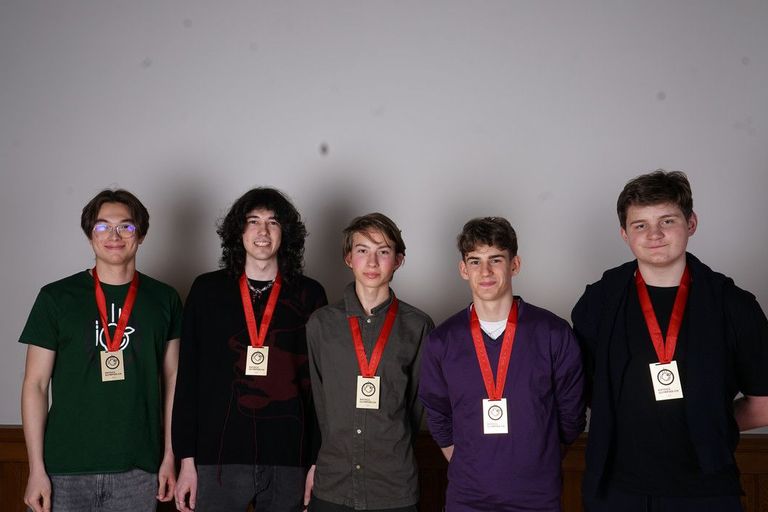
Am 7. und 8. März fand an der Alten Kantonsschule Aarau das Finale der Schweizer Physik-Olympiade statt. 27 Jugendliche zeigten ihr theoretisches und praktisches Wissen. Fünf von ihnen wurden mit Goldmedaillen ausgezeichnet:
Image: Physik-Olympiade
Symmetrie
Vortrag von Dr. Hans Walser, Mathematiker
Image: Hans Walser
Florencia Canelli appointed CMS Deputy Spokesperson
Florencia Canelli, Professor of Physics at the University of Zurich, has been appointed Deputy Spokesperson of the CMS Collaboration for the period 2026–2028. In this role, she will support the newly elected Spokesperson Anadi Canepa in coordinating the scientific activities of one of the world’s largest particle physics collaborations, which brings together more than 6000 scientists, engineers and students. Florencia Canelli joined CMS in 2012 and has since held several leadership positions within the experiment. Her appointment highlights the important role played by Swiss institutions in the Compact Muon Solenoid experiment at CERN.
Image: CERN
Transition in SHiP Physics Coordination
After twelve years guiding the physics programme of the SHiP Collaboration, Nicola Serra (University of Zurich) is stepping down as Physics Coordinator. Following the recent collaboration election, Lesya Shchutska (EPFL) will take over the role. With this transition, the coordination of SHiP remains in Switzerland, highlighting once again the strong contribution of Swiss institutions to the experiment.
Image: CERN, SHiP
Boiling the vacuum
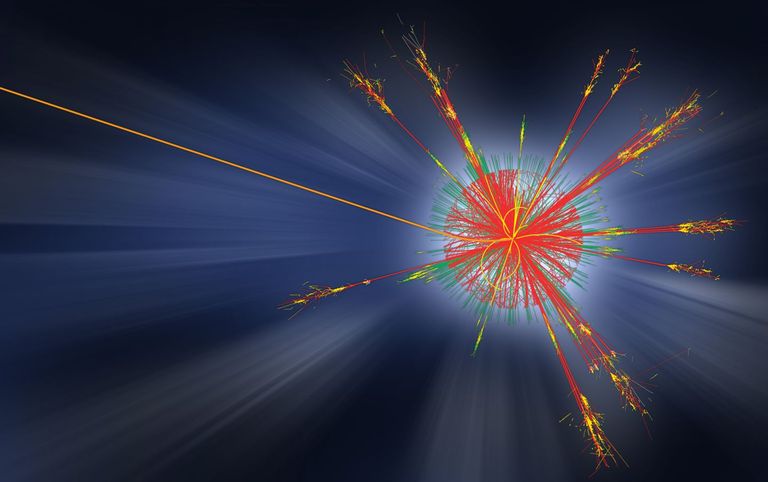
A group of scientists has set out to shed light on an unexplored area of physics using a high-energy electron beam, a laser, a vacuum chamber and a set of detectors. Federico Meloni, scientist at Germany’s national accelerator lab DESY and since December professor at the University of Bern, explains what the “LUXE” experiment is all about.
Image: CHIPP
Cristina Benea – quantum optician
Cristina Benea takes us inside her laboratory at EPFL, where she works on cutting-edge research in quantum optics and photonic chips.
Image: Benedikt Vogel und SCNAT