

Commodity trading could be a particularly strong lever for sustainable development
Trade in raw materials represents one third of total trade in goods and has a considerable impact on sustainable development. In the most comprehensive scientific study to date conducted by the Swiss Academy of Sciences (SCNAT), researchers analysed the influence of trading companies on economic, ecological and social development and show how Switzerland, as a major trading hub, can exploit opportunities and minimise risks worldwide.
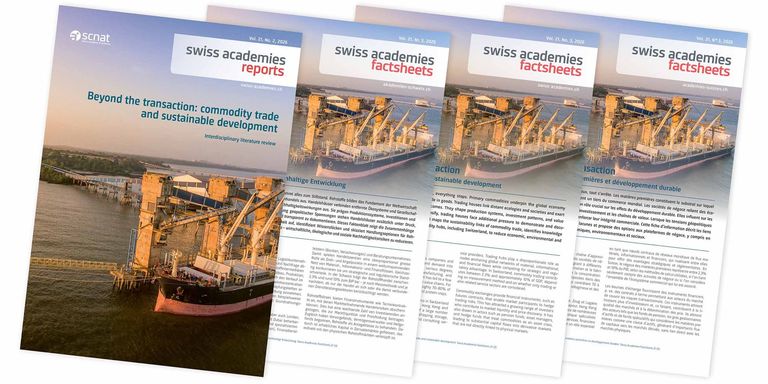
The researchers, led by SCNAT's Swiss Alliance for Global Research Partnerships and ETH NADEL, analysed hundreds of studies. These show that trade in energy resources, food and minerals offers economic opportunities, but also has a negative impact on the environment and strongly influences land use and society. For example, one third of endangered animal and plant species are under pressure due to the commodities trade and around one quarter of global water consumption can be attributed to traded commodities.
Commodity traders become potent financial players
Commodity trading has changed significantly in recent years, however. Retailers' gross margins are 2.5 times higher than in the 2010s. During this time, commodity traders' control over the entire value chain and integration with the global financial markets increased significantly. Commodities are increasingly seen as an "asset class" and the commodities sector now generates more income from financial transactions than from actual commodities trading. This "financialisation" increases price volatility, particularly in times of crisis, and also the risk of shocks being transmitted to other sectors.
Sustainability regulations are too fragmented, with limited impact to date
The researchers also analysed studies on the impact of standards and regulations. Voluntary standards, multi-stakeholder initiatives and certifications only have an isolated influence on commodity trading's impact on the environment, social conflicts or corruption. Legal requirements for traceability and due diligence have only recently been developed further. The researchers noted that expansion of sustainability regulation in recent years has so far achieved only limited results, particularly because of fragmented requirements and inconsistent implementation. And this expansion could come under pressure in the wake of geopolitical tensions if security of supply is prioritised unilaterally.
Switzerland can play a central role in containing systemic risks
Switzerland is home to some of the world's biggest commodities trading hub. It handles around 60% of the global copper, aluminium and iron ore trade, 56% of the trade in vegetable oils, 53% of the coffee trade and 39% of the crude oil trade. As a result of this central role, Switzerland can play a "catalytic role in advancing a more coordinated approach across hub jurisdictions". In order to take advantage of economic opportunities and reduce systemic risks, coherent and consistent regulation can enable cross-sector and cross-border governance of commodity trading and generally increase traceability and transparency of transactions.
For the "Beyond the transaction: Commodity trade and sustainable development" report, more than 30 experts from eleven research institutes analysed current studies on legal, economic, ecological, political and social issues. The key findings have been compiled in a fact sheet.

Contact
Dr. Fabian Käser
SCNAT
Swiss Alliance for Global Research Partnerships (GRP-Alliance)
House of Academies
PO Box
3001 Bern
Switzerland