Our sun

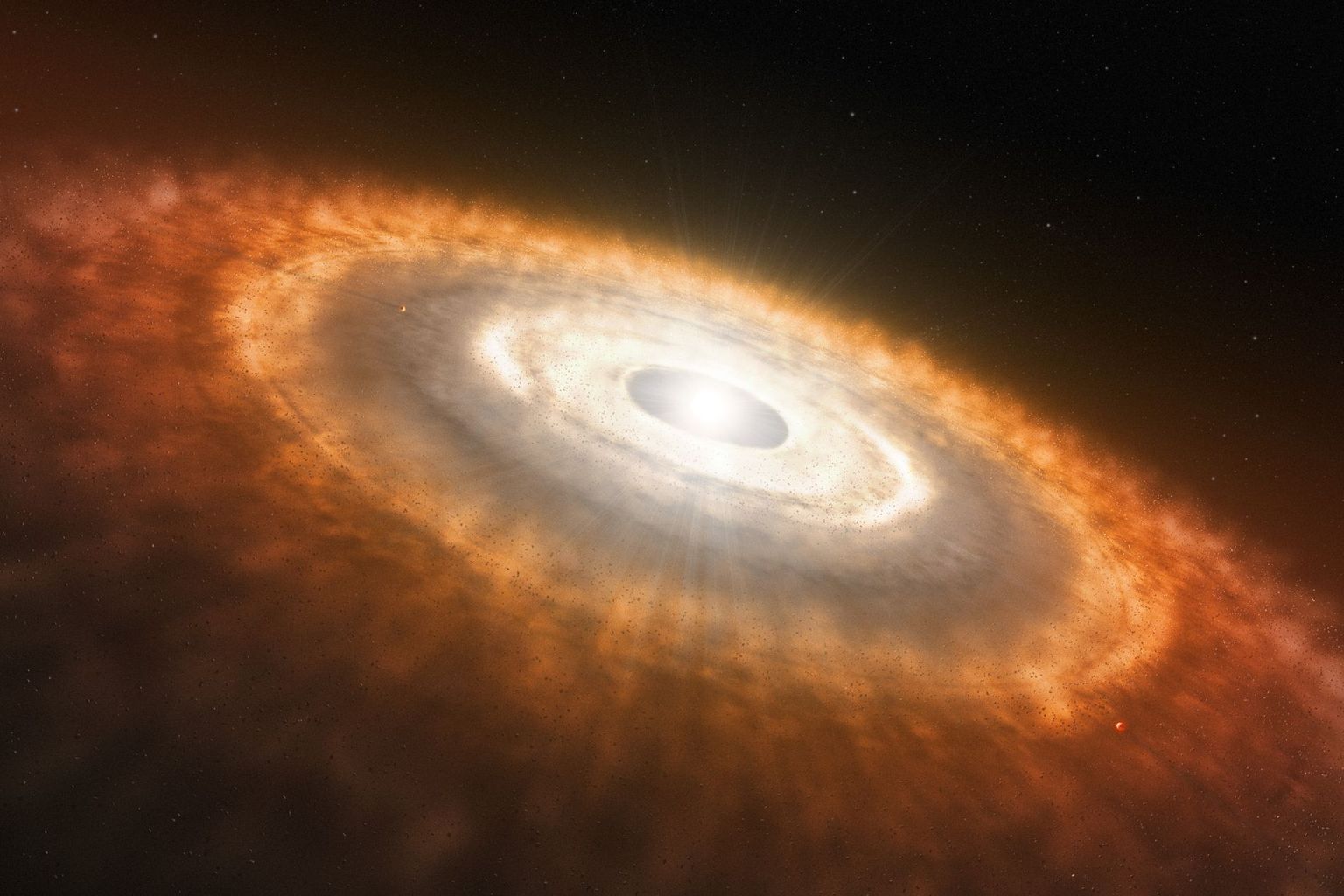
Around 4.7 billion years ago, a new star was formed in a branch of the Milky Way - our Sun. Following a period as a protostar, it developed to become a yellow dwarf, a state in which it is still today. After its current phase as a yellow dwarf, the Sun will become a red giant and eventually end up as a white dwarf in six to seven billion years. Although there are billions of stars like the Sun, it has a very special significance for us. Its proximity to Earth makes life on our planet possible.
The Sun is a hot ball of gas without a solid mass, consisting of different layers (like an onion) and rotating on its own axis. As it is very hot, the gas is in the form of plasma. This means that electrons have been released from the atoms, and the gas contains positively and negatively charged particles.
Energy from the core to the surface
The Sun produces all the energy that we perceive as light and heat in the innermost layer, the core. Energy is produced through nuclear fusion. The pressure and heat are so enormous that every four hydrogen atoms create a helium nucleus. During this reaction, mass is lost and released as energy. This makes its way through the radiative zone and then the convective zone to the surface of the Sun and from there into space to us on Earth.
In the radiative zone, energy is transported primarily by photons that collide with plasma particles and are absorbed. The collision causes further photons to be emitted, which in turn collide with plasma particles. And so it goes on and on. This transportation method is extremely slow. It takes millions of years for the energy produced by the nucleus to leave the radiative zone again.
The energy then enters the convective zone. It is too cold here for the radiative transport described above. Instead, the energy rises through the movement of matter (i.e. convection). Streams of matter reach the surface of the Sun, cool down and sink back again.
The solar surface consists of three more layers: the photosphere, the chromosphere and the corona. During a solar eclipse, we can even see the corona as a ring around the Sun with the naked eye.
Magnetic field causes turbulence
The tachocline region lies between the radiative and convective zones. The Sun moves like a massive body below the tachocline. Above the tachocline, the Sun moves at different speeds, depending on where one measures between the pole and the equator. These different speeds have an effect on the Sun's magnetic field. This is not evenly distributed, being stronger in some places and weaker in others. This causes various observable phenomena such as sunspots, these being slightly cooler places on the surface that appear darker to us. Prominences are curved magnetic field lines that protrude from the Sun and on which gas accumulates. Or flares, which are sudden eruptions of large amounts of plasma into space.